Introduction
The Thread Environment Block (TEB) and Process Environment Block (PEB) are data structures that contains information about the thread and process. The TEB and PEB is commonly accessed by developers and threat actors to obtain information about the process and the system.
Thread Environment Block

The Thread Environment Block (TEB) is also known as Thread Information Block (TIB) is the _TEB data structure in both 32-bit and 64-bit systems and it contains information about the current running thread. The TEB data structure contains pointers to Process Environment Block, Structured Exception Handler, and much more which is available at Wikipedia
- In 32-bit systems the TEB can be accessed through
GS:[0x18]. - In 64-bit systems the TEB can be accessed through
GS:[0x30].
The TEB is commonly accessed to access the PEB data structure which allows us to access informations about the process.
Process Environment Block

The Process Environment Block (PEB) is the _PEB data structure that contains information about the process itself. The PEB contains informations such as BeingDebugged, Ldr, Process Parameters, OSBuiidNumber, and much more which is available at Wikipedia.
- In 32-bit systems the PEB can be accessed through
FS:[0x30]. - In 32-bit systems the PEB can be accessed through
FS:[0x60].
The PEB is commonly accessed to access the Ldr data structure as it points to InLoadOrderModuleList which contains all the modules base address, names, and etc…
LDR

The Process Environment Block (PEB) has a pointer to Ldr which is the _PEB_LDR_DATA data structure that will allow us to locate all modules loaded by our process.
- InLoadOrderModuleList : The list is sorted by the order the modules were loaded.
- InMemoryOrderModuleList : The list sorts the modules by the base address.
- InInitializationOrderModuleList The list is sorted by the order which the modules were initalized.
The main difference between these different pointers is the way modules are sorted, this doesn’t matter much for us as we enumerate through them.
WinDBG Traversal
In this section I’ll go through analyzing the TEB, PEB, LDR and the way to locate modules.
-
Attach
Windbgto any process. -
Use the command
dt ntdll!_TEB @$TEBto access TEB.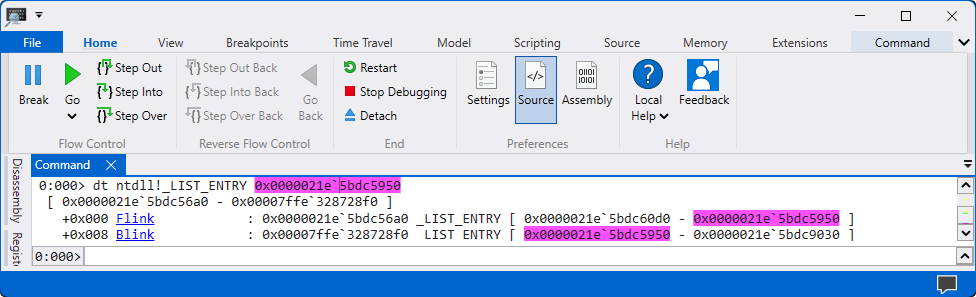
-
Use the command
dt ntdll!_PEB <PEB-ADDRESS>to access PEB.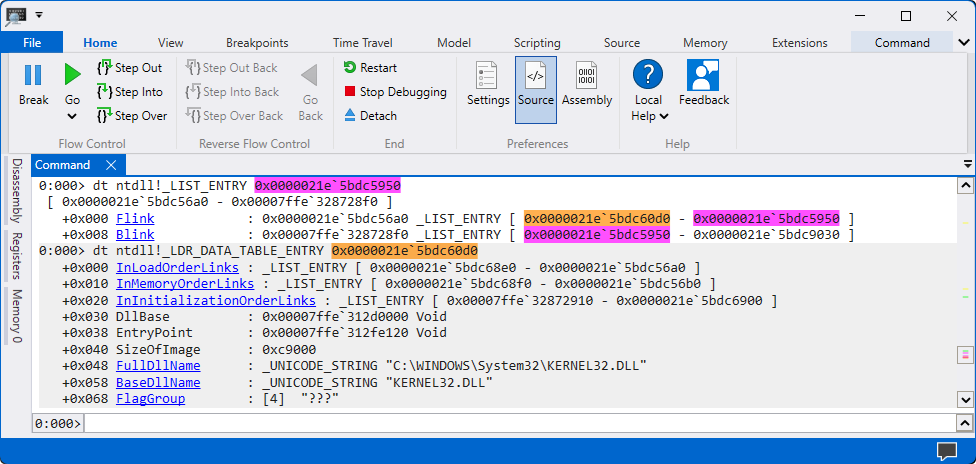
-
Use the command
dt ntdll!_PEB_LDR_DATA <ADDRESS>to access the data structure which consists of different stages of loaded modules.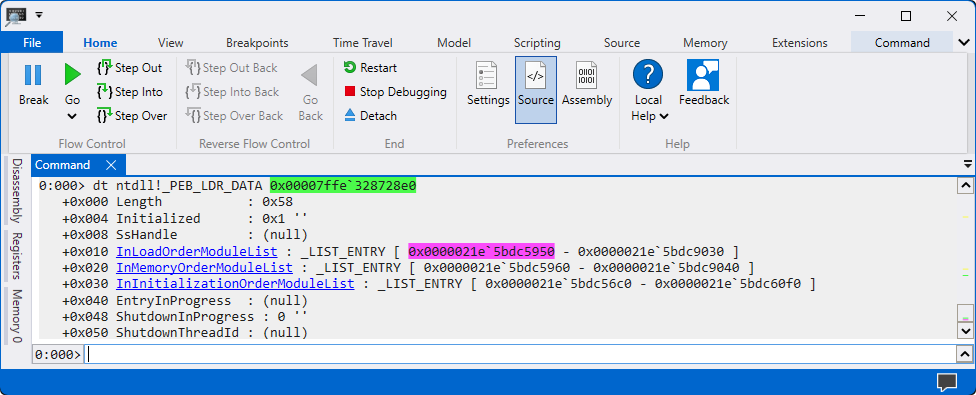
-
Use the command
dt ntdll!_LIST_ENTRY <ADDRESS>to obtain address of a module.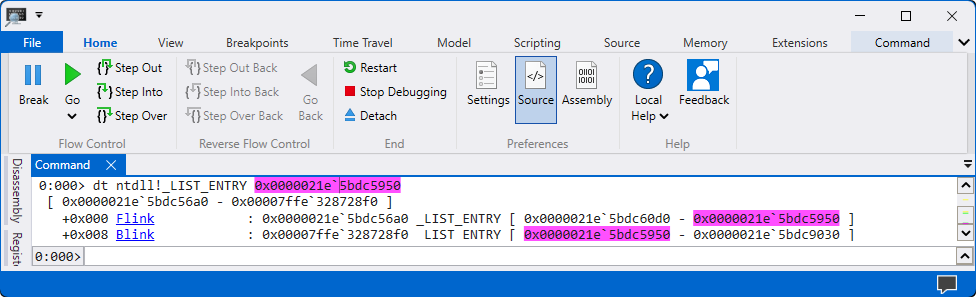
-
Use the command
dt ntdll!_LDR_DATA_TABLE_ENTRY <ADDRESS>to obtain information about the module.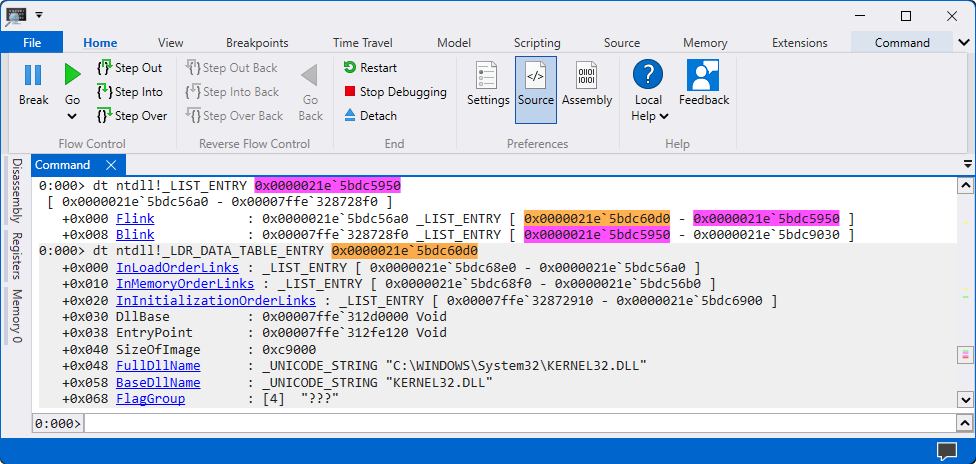
Traversing with Code
I understand that it can be difficult to grasp the TEB, PEB, and LDR concepts therefore I programmed an terminal application which enumerates through all loaded modules in our process to access DllBase and DllBaseName.
use std::{os::raw::c_void};

#[repr(C)]
struct _TEB {
    Reserved : [u8; 0x60],
    ProcessEnvironmentBlock  : *mut _PEB
}

#[repr(C)]
struct _PEB {
    Reserved : [u8; 0x10],
    ImageBaseAddress: *mut c_void,
    Ldr : *mut _PEB_LDR_DATA
}

#[repr(C)]
struct _PEB_LDR_DATA {
    Reserved: [u8; 0x10],
    InLoadOrderModuleList : _LIST_ENTRY,
    InMemoryOrderModuleList : _LIST_ENTRY,
    InInitializationOrderModuleList: _LIST_ENTRY
}

#[repr(C)]
struct _LIST_ENTRY {
    Flink : *mut _LDR_DATA_TABLE_ENTRY,
    Blink : *mut _LDR_DATA_TABLE_ENTRY
}

#[repr(C)]
struct _LDR_DATA_TABLE_ENTRY {
    InLoadOrderLinks : _LIST_ENTRY,
    InMemoryOrderLinks : _LIST_ENTRY,
    InInitializationOrderLinks : _LIST_ENTRY,
    DllBase : *mut c_void,
    EntryPoint : *mut c_void,
    SizeOfImage : u32,
    Reserved1 : u32,
    FullDllName : _UNICODE_STRING,
    BaseDllName : _UNICODE_STRING
}

#[repr(C)]
struct _UNICODE_STRING {
    Length : u16,
    MaximumLength : u16,
    Reserve: u32,
    Buffer : *const u16
}

fn main() {
    let teb : *mut _TEB;

    unsafe {
        std::arch::asm!(
            "mov {teb}, gs:[0x30]",
            teb = out(reg) teb,
            options(nostack, nomem)
        );

        println!("_TEB Address: {:?}", teb);
        println!("_TEB -> _PEB Address: {:?}", (*teb).ProcessEnvironmentBlock);
        println!("_TEB -> _PEB -> _PEB_LDR_DATA Address: {:?}", (*teb).ProcessEnvironmentBlock);
        println!("_TEB -> _PEB -> _PEB_LDR_DATA -> InLoadOrderModuleList Address: {:?}", (*(*teb).ProcessEnvironmentBlock).Ldr);

        let mut begin_list = (*(*(*teb).ProcessEnvironmentBlock).Ldr).InLoadOrderModuleList.Flink;
        let end_list = (*(*(*teb).ProcessEnvironmentBlock).Ldr).InLoadOrderModuleList.Blink;

        while begin_list != end_list {
            let base_dll_name = &(*begin_list).BaseDllName;
            let len_u16 = (base_dll_name.Length / 2) as usize;
            let wide : &[u16] = std::slice::from_raw_parts(base_dll_name.Buffer, len_u16);
            let s = String::from_utf16_lossy(wide);

            println!("Module Name: {:?}\t\tModule Location: {:?}", s, (*begin_list).DllBase);

            begin_list = (*begin_list).InLoadOrderLinks.Flink;
        }
    }
}> cargo run
_TEB Address: 0x72ab8db000
_TEB -> _PEB Address: 0x72ab8da000
_TEB -> _PEB -> _PEB_LDR_DATA Address: 0x72ab8da000
_TEB -> _PEB -> _PEB_LDR_DATA -> InLoadOrderModuleList Address: 0x7ffe328728e0
Module Name: "peb.exe" Module Location: 0x7ff74d7a0000
Module Name: "ntdll.dll" Module Location: 0x7ffe326a0000
Module Name: "KERNEL32.DLL" Module Location: 0x7ffe312d0000
Module Name: "KERNELBASE.dll" Module Location: 0x7ffe2ff90000
Module Name: "ucrtbase.dll" Module Location: 0x7ffe2f820000All the code does is it accesses the TEB by using GS:[0x30] and from there it accesses the different data structures such as _TEB, _PEB, and _PEB_LDR_DATA to access the different modules loaded by our process.
Conclusion
Understanding the purpose of TEB and PEB can be difficult as it requires us to understand the way structures, pointers, and offsets works. I would recommend getting hands on experience by programming an simple application which enumerates through the TEB and PEB to find the InLoadOrderModuleList and then enumerate through all the libraries.